Friday, August 11, 2017

Week 5-1 Reflection

1.) Leave a 30-word micro session summary.
-It has been proven that positive feedback and providing an "emotional availability," (among other things) to students will decrease negative emotions. In turn, creating positive emotions that will result in an improved learning experience.

2.) From a student's perspective, what messages/opinions do you want to add to the students’ voices appeared in the videos in terms of students’ emotional needs and expectations for teacher support in the classroom learning situation?
-One message that I would want to add (from a students perspective) is that if the teacher see's that I am struggling during a test then please do not assume that I did not bother studying. The teacher should try to evaluate why I would have anxiety during a test. Some reasons could be that I did study however the questions may be confusing to me, I may not know what some words mean, and I could be thinking about what will happen to my grade if I fail the test. My expectations as far as my teacher support would be to give me five minutes longer to take a test so that I can sort through some questions and to help me think of exercises to help me lower my anxiety during a test.

Image result for student emotional needs
3.) This time I want you to respond to the students’ voices heard in the two videos (including your message/opinions written in #2) from a teacher’s perspective. What can/will you as a teacher do to support students’ emotional needs and experiences in the classroom learning situations?
-One thing that I would want is to support emotional needs in the classroom. If I have students that get anxiety during tests and as a result do poorly then provide an extra credit assignment (having to do with what was on the test) and have the students earn back some of their grade whether it be writing an essay or doing a project. As far as helping students with emotional needs inside the classroom I would want them to know that they can talk to me about anything and if they do not do assignments due to their anxiety then we could work out a homework arrangement so that their grades do not suffer.

4.) What can you do to support these students’ emotional struggles and needs and successful learning experiences?
-I would want to encourage these students that they can do anything and I would let them know that just because it may take them a little longer to learn the material it does not mean that they are slow or stupid. I would let them know that everyone learns at their own pace and that there is no such thing as a "stupid" student. If that is not enough then I would set up an after school/morning program where students can learn in peace without the pressures from other students hindering their thoughts and providing negative emotions. I would want to create an environment that creates positive emotions leading to learning.
Image result for motivational quotes

5.) Do you have any questions or concerns about course learning?  
-None at this time.

6.)

Modules
Topics  & Activity
Check  if Completed
Week 5
Week 5-1

*Due by August 12 at 10:59 am

1) Week 5-1 Reading Quiz
 ✔
2) Week 5-1 Discussion Forum: one initial response & two peer feedback replies
 ✔
3) Final Blog Activity Survey
 ✔
4)  Week 5-1 Personal Blog Reflection
 ✔
Week 5-2

*Due by August 12 at 10:59 am

1) Week 5-2 Reading Quiz
 ✔
2) Week 5-2 Discussion Forum: One initial response & two peer feedback replies
 ✔
3) Week 5-2 Personal Blog Reflection

 4) TPS Final Submission


7.) Hey Sammi!
So as I was reading through your blog (which was great), one thing that stood out to me was you saying that one should not make students feel like outsiders. This is such a true statement because if a student does not feel comfortable and they feel unwanted then the last thing they will want to do is be in class, much less learn about what is going on in class. So I thought that was a great point!
-Melissa
Marissa,
I like how in question #3 you said that you would be a welcoming mentor and advocate because I feel that some teachers forget that teaching isn't the only thing they have to do as teachers. Teachers also have to remember that if the student is not in a good place then the student will not do as well as they should in class. Which is why I think teachers both need to be the person who guides their students through education but also emotionally so that they know they are not alone.
-Melissa

Monday, August 7, 2017

Week 4-2 Blog Reflection


Image result for student learning strategies

1.) Leave A 30-Word Micro-Session Summary.
-By adding instructional strategies to a classroom that focuses on student-centered learning the students will both contribute to the lesson and make better connections in the things that they are learning.

2.) In the article (p. 262), the authors mentioned the importance of supporting higher-order thinking skills in undergraduate education since business and industry appeals for flexible and creative employees who can look beyond the numbers and the given information. For that reason, the authors advocated pedagogical approaches that strive to develop students’ abilities to (1) synthesize disconnected pieces of information, (2) associate facts received from different sources and (3) evaluate the importance of information.

As a student, how would you evaluate your overall college classroom learning experience in terms of developing your higher-order thinking skills? Do you think your college courses have sufficiently supported you to develop the three -(1), (2), and (3)- abilities so far? If so/not, why do you think so?
-I believe that overall my college experience at UConn has developed my higher-order thinking skills in reference to developing my three abilities. I think they have helped me develop these skills through tests and the importance my passed professors have put into their lectures. The lectures that I have experienced so far are important because that is the basis a student needs in order to do well in the class. For instance, the student needs to know the lecture in order to do well in homework, essays, and tests. When I have to do these assignments, I have to use the three abilities (that the question mentioned) and as I use these three abilities, I have to be creative but also think critically. In the long run, I think this has helped me become a better student and has also helped me professionally because as a Medical Assistant one has to be on their toes, think critically, and solve problems on your own that will best benefit the patient.
3.) On page 268, Bonk and Smith (1998) suggested that students in a consultative classroom encounter a wide range of classroom activities and assessment practices. Do you think consultative teachers are more likely to incorporate various instructional strategies into instruction than traditional teachers? Read page 267 and 268 and tell me your thoughts.
I do believe that consultative teachers are more likely to incorporate instructional strategies because as the text stated: "A consultative approach strives to develop students abilities for abstract thinking problem definition interpretation and synthesis with less structured interdisciplinary problems. In essence this open ended teaching method forces students to accept responsibility for their own learning." In other words, consultative teachers want their students to take responsibility for their learning by doing whatever they can to make connections with the material through real life situations and not to depend solely on the textbooks. Which is why I believe that instructors would use instructional strategies such as the jigsaw and fish bowl methods because this gives students a chance to talk to each other and see the material through other students' eyes and how one student seeing the material a certain way may help another student learn that same material.
Image result for student learning strategies

4.) From a consultative teacher’s perspective, name one instructional strategy that you find the most effective for 1) designing a student-centered instruction and 2) developing students’ creative thinking skills among the alternative instructional strategies for creative thought (p. 269-275) that the authors suggested. Back up your choice by
- applying your knowledge of student-centered instruction
- referring to the definition and the characteristics of creative thinking suggested by the authors on p. 263, 264.
- briefly describing how this strategy will support college students to develop their creative thinking skills
-One instructional strategy that I would suggest that would come from a consultative teacher's perspective would be reverse brainstorming because in order for a student to think creatively this would be the perfect exercise. The example of reverse brainstorming that was given in the text was asking students how costs could be increased at the nearby hospital. These types of examples would help a student think creatively because whatever answers are brainstormed by the students will not be answers that you will find in a textbook which is why if those answers make sense then the students will just have learned new methods to solve a "real-life" problem by thinking outside the box and not strictly going by a what a textbook has to say. I think that this strategy can help college students in general develop their creative thinking skills because in my opinion students rely to heavily on their textbooks or what the internet has to say. By using this method, the answers that they are given are answers that the student had to think long and hard about (using what they already know about the material to think of an answer) and the answers that the students give are not answers that they will find in a textbook or Google.
Image result for creative thought
5.)  From a consultative teacher’s perspective, name one instructional strategy that you find the most effective for 1) designing a student-centered instruction and 2) developing students’ critical thinking skills among the alternative instructional strategies for critical thought (p.276-284)  that the authors suggested. Back up your choice by
- applying your knowledge of student-centered instruction
- referring to the definition and the characteristics of critical thinking suggested by the authors on p. 264, 265.
- briefly describing how this strategy will support college students to develop their critical thinking skills 
-The instructional strategy that I would find most effective to develop students critical thinking skills and to fit best within the student-centered instruction would be the KWL method which means what the student knows, what they want to know, and what they have learned. I like this strategy because it makes the student think critically about what they already know. It makes them realize what they want to learn and how they can go about achieving that, and what they finally learned at the end of this exercise. Plus by doing this exercise within a student-centered instruction environment the students can ask each other what they know, how they can go about learning it either through each other or by asking the instructor what they can do in order to learn the material. And by the end of this exercise they will feel a greater accomplishment because they took the time to learn something new by themselves. Which is why I think this would help college students and their critical thinking skills because most college students just try to learn everything at once. However, if they break it down into the KWL method, I believe that students will realize that they know more than they thought, they will focus better on what they want to learn, and they will feel, as I said earlier, a greater sense of accomplishment because they took the time to learn it.
Image result for critical thought

6.) Do you have any questions or concerns about course learning? 
-I do not have any questions or concerns at this time.

7.) 

Modules
Topics  & Activity
Check ✓ if Completed
Week 4
Week 4-1

*Due by August 8 at 10:59 am

1) Week 4-1 Reading Quiz
 ✔
2) Week 4-1 Discussion Forum: one initial response & two peer feedback replies
 ✔
3) Week 4-1 Personal Blog Reflection
 ✔
Week 4-2

*Due by August 8 at 10:59 am

1) Week 4-2 Reading Quiz
 ✔
2) Week 4-2 Discussion Forum: One initial response & two peer feedback replies
 ✔
3) Week 4-2 Personal Blog Reflection
 ✔

8.) Blog Responses 
Hello Miranda!
I like the instructional strategy that you put for the critical thinking method and how it would best support critical thinking in students. I personally like the KWL method because it makes students think critically about what they already know (because they might find that they know a lot more than what they give themselves credit for), what they want to learn (maybe they will realize they want to learn more about a certain topic), and what they have learned through this exercise because I believe it would give them a greater sense of accomplishment.
-Melissa Parkes

Hello Carl!
I like the strategy that you put the free writing strategy for how a student would help develop their creative thinking skills. After much thought, I would have to say that this is one of the best strategies for creative thinking. I put reverse brainstorming because the students are given a hypothetical situation and they have to discuss responses either in groups or as a class. I liked this approach because the answers that come from the students are not answers that they cannot find in textbooks or on Google.
-Melissa Parkes


Week 4-1 Blog

1.) 30 Word Micro-Session Summary
-When a classroom uses the teacher-centered approach the teacher controls the lesson. However, when a classroom uses the student-centered approach students control the lesson which results in many advantages when it comes to student learning.

2.) Thinking Back Of Your Prior Learning Experiences In The Classroom As A Student, How Teacher-Centered Classroom Teaching Approaches Such As Direct Instruction Have Influenced Your Personal Learning?
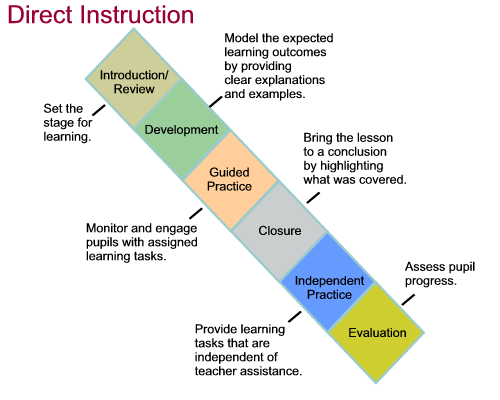
-After watching the video "Direct Instruction in K-8" this made me have a flashback to my 4th grade class, when learning the multiplication tables. It was a teacher-centered classroom that actually used the direct instruction (like in the video). It has influenced my personal learning because the teacher takes the time to teach the basics of the topic and eventually as the class gets better the teacher starts to yell out problems and the classroom shouts out the answer. Instances like this have influenced my personal learning because it kept me aware of what was going on and I was never confused in what part of the lesson was important (because the teacher always made it known what should be known and what shouldn't be).
Image result for direct instruction

3.) Tell Me Any Of Your Thoughts/Opinions/Perspectives About Teacher-Centered Instruction Reflecting What You Have Watched In The Following Videos.
-My thoughts about teacher-centered instruction is that I think it's a great method for younger students (i.e. elementary) because the teacher is in control of what will be taught, how it will be taught, the teacher does most of the decision making and the students always goes off of what the teacher says. But in my opinion, I feel that once students get older the teacher-centered instruction should switch to student-centered instruction because most of the time older students know what they want to learn and at least this way the lesson turns less into a lecture and more into an intellectual conversation between teacher and students. Which is why I think it's more beneficial since students remember the material more (able to recall it better) because they're able to think back to the intellectual conversation they were a part of.
Image result for teacher centered instruction       Image result for teacher centered instruction

4.) Tell Me Your Thoughts About Teacher-Centered Vs Student-Centered Teaching Regarding This Video. Do You Believe That A Student-Centered Teaching Model Can Enhance Students' Learning Experiences And Outcomes? If So/Not Why?
-I believe that student-centered instruction is better than teacher-centered instruction because as the video states, student-centered instruction have four main components. Which is: Learning is personalized, competency based, learning happens at anytime and anywhere, and students take ownership. This enhances the students learning because all students are put on the same level (no one is just getting by), everyone goes off of their competency levels, and my favorite, the students and teachers end up having an intellectual conversation and not just a lecture. This way, students are able to express things about their education and communicate what can be done to improve the curriculum.
Image result for student centered instruction

5.) From A Teacher's Perspective, Name One Student-Centered Teaching Approach That You Think Is Most Effective And Also Practically Doable In The K-12 And/Or College Educational Settings (Out Of The Five Student-Centered Teaching Approaches Introduced In The Video Folder) And Tell Me The Reason You Think So.
-One student-centered teaching approach that I think would be most effective in any grade level would be, being very clear about how to do well in the class. In my opinion, I believe that if a teacher/professor explains how to do well in their class then the students know what they have to do to get a good grade, they know whats expected of them, and if the students know that they'll need help ahead of time then they will be able to communicate that to the teacher/professor and then at least teacher and student can think of a plan of what to do in order to help the student.
Image result for student centered instruction

6.) Do You Have Any Questions Or Concerns About Course Learning?
-I do not have any questions or concerns at this time.

7.)

Modules
Topics  & Activity
Check ✓ if Completed
Week 4
Week 4-1

*Due by August 8 at 10:59 am

1) Week 4-1 Reading Quiz
 ✔
2) Week 4-1 Discussion Forum: one initial response & two peer feedback replies
 ✔
3) Week 4-1 Personal Blog Reflection
 ✔
Week 4-2

*Due by August 8 at 10:59 am

1) Week 4-2 Reading Quiz

2) Week 4-2 Discussion Forum: One initial response & two peer feedback replies

3) Week 4-2 Personal Blog Reflection


8.) Feedback Comments
Hello Maureen!
As I was reading your blog I had to agree with what you said in answer #2. I do believe that in some classes it is best to have the teacher-centered approach (like for example your history class), to be honest some classes are just built for that approach. However, as you said, there are other classes that benefit better with the student-centered approach. Personally I am a fan of the student-centered approach and if it can be used in a classroom then I feel that it should be applied since I believe that students will benefit more from it.
-Melissa Parkes

Hello Miranda!
As I was reading your blog I liked what you said about the teacher-centered approach and how the videos made the teachers looked too authoritative. I personally as a student, would not do too well in an environment like that because if I feel that I am being pressured for an answer or if I am put on the spot then I will most likely not give an answer and will not feel comfortable. And in an learning environment the students have to feel comfortable in order to learn and succeed which is why I am a firm believer in the student-centered approach. Plus, I feel like students do better when it is student-centered because they may feel less pressured by their peers.
-Melissa Parkes