Sunday, July 30, 2017

Week 3-2 Reflection

1.) Micro-Session Summary
In order for an individual to learn they must have a More Knowledgeable Other to help them through the learning process when this occurs their Zone of Proximal Development increases leading to a successful student.

Image result for student helping studentImage result for teacher helping student         

2.) What Is Learning From Vygotsky's Social Constructivism Perspective?
Vygotsky believed that all students will learn more productively when they are in group activities and are able to communicate with one another. For instance, if a student needs help the teacher (or anyone who is more knowledgeable) the MKO (more knowledgeable other) will come over and give their assistance (scaffolding) when they do an example together the teacher will let the student do the next example on their own which is widening their ZPD (zone of proximal development). The teacher will take it one step further  and take away the scaffolding (since the child understands the material) and will have that student teach another student widening everyone's ZPD. In turn, when the child is allowed to communicate their questions or concerns this provides for more effective learning.
 Image result for group activities for kids

3.) What Are The Big Things That You Learned About Vygotsky's Social Constructivism?
One thing that I learned in this section is that scaffolding is not simply assisting the student when they need help. Scaffolding involves intentionality, appropriateness, structure, collaboration, and internalization. Each steps involves the instructor being clear, poses a question that can be solved, a structure for the task at hand that the student will be able to follow, the instructor must respond to the students thoughts, and finally the student will internalize the material. I realized that scaffolding is not simply helping a student but developing a sequence so that the student will learn the material.

                                                               Image result for vygotsky quotes

4.) Do You Think Vygotsky's Social Constructivism Demonstrates Your Own Beliefs In How Human Learning Occurs Well? If So/Not, Why?
I think that this does demonstrate my own beliefs because I have always been a firm believer in children learning better when they are able to communicate with each other in groups. For one, a child might be self conscious and may not want to ask a question in front of the entire class however when they are placed in a group they will feel more comfortable with their peers and will feel more of a need to ask questions, participate more, and will be able to give advice to others that may need help. For instance, in the video that was assigned this week, "Peer Tutoring in Math," the students helped one another out creating for a deeper understanding in the material.
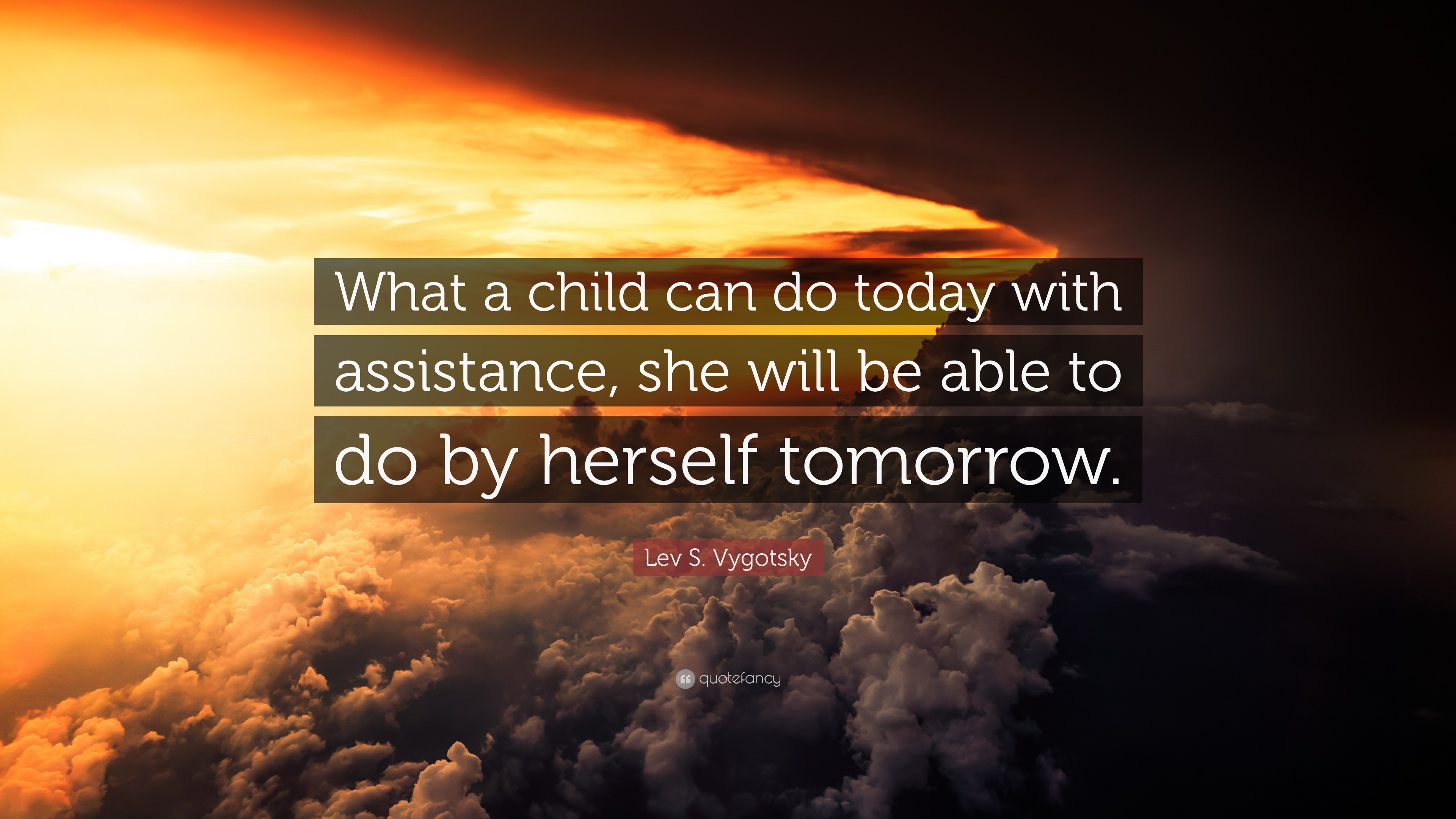
                                                                            Image result for vygotsky quotes

5.) Do You Have Any Questions Or Concerns About Course Learning?
I do not have any questions or concerns at this time!

6.)

Modules
Topics  & Activity
Check ✓ if Completed
Week 3
Week 3-1

*Due by July 31 at 10:59 am

1) Week 3-1 Reading Quiz
 ✔
2) Week 3-1 Discussion Forum: one initial response & two peer feedback replies
 ✔
3) Week 3-1 Personal Blog Reflection
 ✔
Week 3-2

*Due by July 31 at 10:59 am

1) Week 3-2 Reading Quiz
 ✔
2) Week 3-2 Discussion Forum: One initial response & two peer feedback replies
 ✔
3) Week 3-2 Personal Blog Reflection
 ✔

7.) Erin Rodriguez's Blog Response:
Erin,
I enjoyed all the animations that you included in your blog to illustrate what you were trying to say. I agree with you that not all people will thrive in a group setting because some people just work better alone. I for one, am one of those people who prefer to work alone. Although every once in awhile I do enjoy a group experiment because it allows one to bounce ideas off each other and wherever an individual is weak in then hopefully the other will be strong in and vice versa. 
-Melissa

Catherine Crouch's Blog Response:
Catherine,
I enjoyed reading your blog and I do agree with you on how nice it is to see how much more children learn when they are in group activities. I have always had a theory that this was true (before this class) and it was nice to see how there is actually a theory that states exactly what I thought. I also like how it emphasizes the role of language and culture since these are things that play a huge role in learning.
-Melissa

Week 3-1 Reflection

1.) Micro-Session Summary
Jean Piaget believed that most individuals will pass through four learning stages in life. Individuals had three basic building blocks in order to learn which was assimilation, accommodation, and a schema.
Image result for assimilation, accommodation, and schemas        Image result for assimilation, accommodation, and schemas

2.) What Is Learning From Piaget's Individual (Cognitive) Constructivism Perspective?
Jean Piaget thought of an entire process on how an individual learns. The essential building blocks being assimilation, accommodation, and a schema. An assimilation is when an individual encounters a new idea and where they must fit this idea into something they already know. This is where accommodation comes in because the individual must accommodate the new knowledge into a schema that they already had set in their minds. The "Schemas, Assimilation, Accommodation" video that was assigned to us this week gives us a visual picture about how these three processes work in ones mind. The individual then experiences equilibration because they must process what they have learned and must work on (for a lack of a better term) balance the mind once again. Besides these building blocks Piaget also discovered that most individuals in life will also pass through 4 Cognitive Development Stages which are: Sensorimotor, Preoperational, Concrete Operational, and Formal Operational. Each stage an individual accomplishes something by the end and once they have they will move on to the next stage.
Image result for jean piaget formal operational stage     Image result for jean piaget formal operational stage
3.) What Are The Big Things That You Learned About Piaget's Constructivism?
One major thing that I learned about this section was how important it is to let a child figure out/work through a task on their own. For instance, in the video that was assigned to us this week, "Double Column Addition Piaget," the teacher was teaching the kids how to add or subtract in a double column fashion. She would let the kids yell out answers, she would write them on the board, and then would take a vote to see what answer was right, and would ask the child who gave the wrong answer if they were sticking to it or not. Most of the time the child would change their mind and go with the rest of the class. However, the ones who wouldn't change their mind, she would let them explain on how they came to that conclusion. Even the children who were correct would explain how they got to their conclusion. Overall, the teacher not correcting them right away, I think is an amazing opportunity because whether the kids are right or wrong, she let them think it out which helps them develop their cognitive skills.

                                   Image result for jean piaget formal operational stage

4.) Do You Think Piaget's Individual (Cognitive) Constructivism Demonstrates Your Own Beliefs In How Human Learning Occurs Well? If So/Not, Why?
I agree with Piaget in terms of the assimilation, accommodation, and schema process. However, as for the four cognitive stages I would have to disagree because I believe that every child is different so one child may be more advanced than another. For instance, the experiments he did in order to develop these stages, was proven that these experiments were too advanced for the age groups. However, if one were to give a child a simpler version of these experiments it was proven that the child could indeed do it. Overall, I think the building blocks (i.e. accommodation and assimilation) are a great concept that could easily be applied to a classroom.


                                      Image result for jean piaget formal operational stage

5.) Do You Have Any Questions Or Concerns About Course Learning?
I do not have any questions or concerns regarding this material.

6.)

Modules
Topics  & Activity
Check ✓ if Completed
Week 3
Week 3-1

*Due by July 31 at 10:59 am

1) Week 3-1 Reading Quiz
 ✔
2) Week 3-1 Discussion Forum: one initial response & two peer feedback replies
 ✔
3) Week 3-1 Personal Blog Reflection
 ✔
Week 3-2

*Due by July 31 at 10:59 am

1) Week 3-2 Reading Quiz

2) Week 3-2 Discussion Forum: One initial response & two peer feedback replies

3) Week 3-2 Personal Blog Reflection


7.) Sammi Mahoney Blog Response: 
Sammi,
I enjoyed reading your blog especially when you mentioned how you did the water experiment with the kids you were looking after. I always felt that this experiment definitely showed the difference in how an older and a younger child thinks. I think it’s even more interesting when the younger child tries to explain why the taller glass has more water, even after they saw you pour a cup of water into the taller glass. Thanks for sharing your findings in regards to that experiment!
-Melissa
Courtney Eaton Response:
Courtney,
As always, I enjoyed reading your blog because you always seem to point out things that I myself have thought about. For instance, before this class (like you) I have never heard of the equilibrium process. In all honestly I thought that the only things I had to know about were schemas, accommodation, and assimilation. Plus, I enjoyed how you reviewed the equilibrium process since it's always nice to have a refresher on what it is.
-Melissa


Sunday, July 23, 2017

Week 2-2 Reflection

1.) According to the cognitive information processing theory learners are compared to computers. This holds true because people will keep or discard information and will pull necessary information when it's needed.

Image result for computers                                                                                  


2.) According to the cognitive information process theory learning is when "information is input from the environment, processed and stored in memory, and output in the form of some learned capability." So in other words, when someone learns something new they will usually store that in their short-term memory. In order to remember for a little longer they will need to move it into their working memory, usually maybe through something like rehearsal. Now, if the person works through their working memory long enough then it can potentially develop into long-term memory to later be retrieved when one needs it. So, learning is clearly no easy process. It is something that takes time to master. For instance, in one reading they mention how one learned to read a map. The act itself is stored in the long-term memory. However, the circumstances surrounding when or why wanted to learn how to read a map could have been long forgotten.
                                                                                 Image result for cognitive information process

3.) One thing that I learned about the cognitive information processing theory is that one video in particular mentioned how if one closes their eyes and someone else is describing a room to that individual, that individual will picture the room. However, the one describing this room will show the individual picturing the room the difference in what was pictured and what it actually looks like. The scenario was interesting because the narrator in the video proves that although we pictured a room it turned out different than the actual room because we retrieved things from our minds that were familiar to us. So essentially, when we are asked to do something we will retrieve data that we have previously learned in our own past. For some reason this example called my attention.

Image result for cognitive information process                                                                                  

4.) This theory does indeed demonstrate my own beliefs because everyone in one way or another learns the same way. The three basic steps being short-term memory, working memory, and long-term memory. We all also for the most part retrieve data in the same way.


5.) At this point in the discussion, I do not have any questions or concerns about this course learning.


6.)

Modules
Topics  & Activity
Check ✓ if Completed
Week 2
Week 2-1

*Due by July 24 at 10:59 am

1) Week 2-1 Reading Quiz
 ✔
2) Week 2-1 Discussion Forum: one initial response & two peer feedback replies
 ✔
3) Week 2-1 Personal Blog Reflection
 ✔
Week 2-2

*Due by July 24 at 10:59 am

1) Week 2-2 Reading Quiz
 ✔
2) Week 2-2 Discussion Forum: One initial response & two peer feedback replies
 ✔
3) Week 2-2 Personal Blog Reflection
 ✔

7.) Social Blog Activity
Hello Miranda!
Under section #3 I like how you mentioned how students learn better/recall information better if the information is being instructed and tested in the same situation. After this section, I now recall situations in school where these theories came into play. And how teachers/professors would spend some time lecturing about the information but then would have us to activities about the information to better remember/understand the information. Who knew all this was happening without us realizing it!
-Melissa

Hello Courtney!
After reading the section about your own beliefs, I will have to agree with you. Although humans are sometimes compared to computers, in reality computers just need to learn something once and it's there forever. While humans actually need to repeat it quite a few times before anything sticks. Applying this to students is one of the top priorities next to having a comfortable work environment. The more comfortable students are in the classroom, then the more prone they will be to asking questions, which eventually leads to repetition in learning new material.
-Melissa

Week 2-1 Summary

1.) An individual will learn when an action is demonstrated. Thus, the teacher must create a positive learning environment by promoting positive reinforcement. In turn, self-efficiency will produce positive student outcomes.

Image result for positive student achievements                                                                          


2.) Learning, according to the social cognitive theory, is when an individual learns by observing both the actions of others and the consequences of those actions. In other words, learning can occur anywhere at any time. Whether it be in a classroom from a teacher or when a child is at a friends house. The learning can also be constructive (i.e. learning how to do math) or social (i.e. learning how to ride a bike at a friends house). Regardless of what an individual learns, positive or negative, the individual will always find out the consequences of the actions that were just learned.
                                                                         Image result for social cognitive theory


3.) What I learned about the social cognitive theory is that I am now aware that no matter what one learns, there will always be a consequence to whatever was learned regardless if it is positive or negative. I am also aware that a child can learn an action from anyone (not just a teacher), especially in an instance like the children in the Bobo video where they learned to hit the doll after they observed the adults hitting the doll. However, a new topic I learned was the self efficacy theory. According to its definition it is when "people's beliefs about their capabilities to produce designated levels of performance that exercise influences over events that affect their lives." I found it fascinating because (in my opinion) self efficacy is when a person is confident in their abilities to perform a task (i.e. math). However, self efficacy and self esteem are two different things because even though an individual is confident in their abilities, they still may feel unsure about their abilities when doubt is inserted in their mind by another individual (i.e. teacher). While on the other hand, I learned that the self determination theory are choices that people make without the influence from outside stimuli. Which also makes sense because it doesn't matter how much effort a teacher makes, if the student makes the choice that they do not want to learn then they will most likely won't since education involves both teacher and student making an effort.
                                                                       Image result for bobo doll


4.) I do believe that the social cognitive theory supports my own beliefs in how human learning occurs because no matter where the child is they will always observe and then do what they observe regardless if it comes from a parent, teacher, or friend, and even an animal! (Some children will crawl on all fours to copy their dog!). If I were to teach a classroom I would apply this theory to the classroom because if the children do not observe what I am doing then hopefully they will observe what their classmate is doing (in regards to the lesson). So in a way, they are still learning regardless if it comes from me or another student (however, I would hope it would come from me!).


Image result for children observing                                                                                 

5.) For this lesson, I did not have any questions or concerns. Yay!


Modules
Topics  & Activity
Check ✓ if Completed
Week 2
Week 2-1

*Due by July 24 at 10:59 am

1) Week 2-1 Reading Quiz
 ✔
2) Week 2-1 Discussion Forum: one initial response & two peer feedback replies
 ✔
3) Week 2-1 Personal Blog Reflection
 ✔
Week 2-2

*Due by July 24 at 10:59 am

1) Week 2-2 Reading Quiz

2) Week 2-2 Discussion Forum: One initial response & two peer feedback replies

3) Week 2-2 Personal Blog Reflection


7.) Social Blog Activity
Hello Marissa,
First off, I really enjoyed reading your blog! I love the way how you explained self-efficacy and also threw in your own personal experience with it. I can, in a way, relate except I had the opposite scenario. In high school I was a B student but now in the passed couple years I have gotten As. Who knew! But I also liked that although you weren't getting As all the time that you did not let that get the best of you!
-Melissa

Hello Sadie!
In the section about what you learned, I completely agree about what happens if the students self-efficacy is too high. Ironically, after reading I was thinking the same thing because in my opinion having a student that has too high a self-efficacy is just as bad as having a student with too low of a self-efficacy. If you ever find out the solution to that let me know!
-Melissa

Sunday, July 16, 2017

Week 1-2 Reflection

Week 1-2 Blog Reflection

1.) Micro Session Summary

No matter what grade level is being taught, there is always a suitable behaviorist technique. Whether it be positive or negative it can produce a suitable learning environment for the students.

Image result for positive reinforcementImage result for positive reinforcementImage result for positive reinforcement

2.) From the behaviorist perspective learning is simply defined as someone who produces new behaviors (whether they are good or bad) due to environmental conditions. My personal definition of learning is close to this but I like to say it in simpler terms! Since it is easier for me to remember! My definition is a new behavior that (in this case) a child learns, regardless if it is positive or negative in nature, due to influences from their peers, family, or other outside stimuli (i.e. movies, shows, music, etc). This definition may be longer but it is easier to understand in my opinion! I also believe that this learning can occur in any environment at any time and at any place. For instance, a child can learn good behavior from their parents and will demonstrate it in the classroom. However, these learned behaviors can be challenged by their peers (in this example, peers who demonstrate disruptive behavior in class). In order to get along with their peers the child will start to demonstrate a new less positive learned behavior suitable (in their mind) to the environment (i.e. the classroom). The child will soon realize that their new behavior is not acceptable in the classroom environment when they eventually get punished by their teacher or parents. The student will hopefully go back to their previous learned behavior so that they can stop getting punished. Clearly, learning is a never ending experience, especially at a young age, but it is something that continues through life.

3.) What Are The Big Things That You Learned About Behaviorism?

I learned many things during this lesson. My personal favorite was the video that was assigned "Behaviorist Classroom Teaching Practice" because it showed the teacher using positive reinforcement such as saying thank you to the children for paying attention and would congratulate them when they said something that was correct. She also had a lot of energy and hand motions that she would instruct the class to do with her. She also had a visual aid at one point to help in the lesson. All these techniques and learning aids kept the children involved and there was never an instant where the children got distracted. I learned that by using positive reinforcement the children will be more inclined to answer questions and participate in class. Another thing I learned is that no matter what grade level one is in these behaviorist techniques will work, they are just simply modified depending on how old the child is. For instance, the other video that was assigned, What Is PBIS, showed how the students are rewarded for good behavior and how they are also punished for bad behavior. Such as, in the elementary school the children have a chart and if their clip stays in the green zone they go to a party rewarding their good behavior. I think this is a good technique to improve good behavior because the students will want to get rewarded whether it be a party or simply appraisal from a teacher or parent. I just found it fascinating how these techniques came to life in the classroom no matter how old the child was.

4.) I do believe that behaviorism demonstrates my own beliefs in how human learning occurs because people (especially children) will always learn through the actions of others. No matter it be a parent, friend, or something as simple as a television show, a child will learn this behavior regardless of it being positive or negative. The good news is, no matter what behavior is learned it means that same behavior can be relearned so as a teacher it is important to either correct the behavior or further elaborate on the behavior. For instance, if a student is misbehaving in class I can choose to deal with the situation through negative reinforcement (having the student stay after class) or I can also choose to have a discussion with the student as to why the behavior is unacceptable. Hopefully, the student will eventually learn a new behavior. If I were to become a teacher I would definitely use these techniques/approaches because the student will know what is expected of them and what is not acceptable in the classroom which would hopefully carry on into everyday life.
Image result for classroom environment

5.) Do You Have Any Questions Or Concerns About Course Learning?

My only question is, is it possible for these techniques to fail? For instance, is it possible for a student to be so difficult that no technique will work? I want to answer my own question and say no but I would like to know someone else's opinion.

Image result for wondering emoji

6.)


Modules
Topics  & Activity
Check ✓ if Completed
Week 1
Week 1-1

*Due by July 17 at 10:59 am

1) Blabber introduction
 ✔
2) Week1-1 Discussion Forum: one initial response & two peer feedback replies
 ✔
3) Initial Blog Activity Survey
 ✔
4) Personal Blog Creation & Week 1-1 Reflection
 ✔
Week 1-2

*Due by July 17 at 10:59 am

1) Week1-2 Reading Quiz
 ✔
2) Week 1-2 Discussion Forum: One initial response & two peer feedback replies
 ✔
3) Week 1-2 Personal Blog Reflection
 ✔